
Choosing the Right Gallbladder Surgeon: A Patient's Checklist
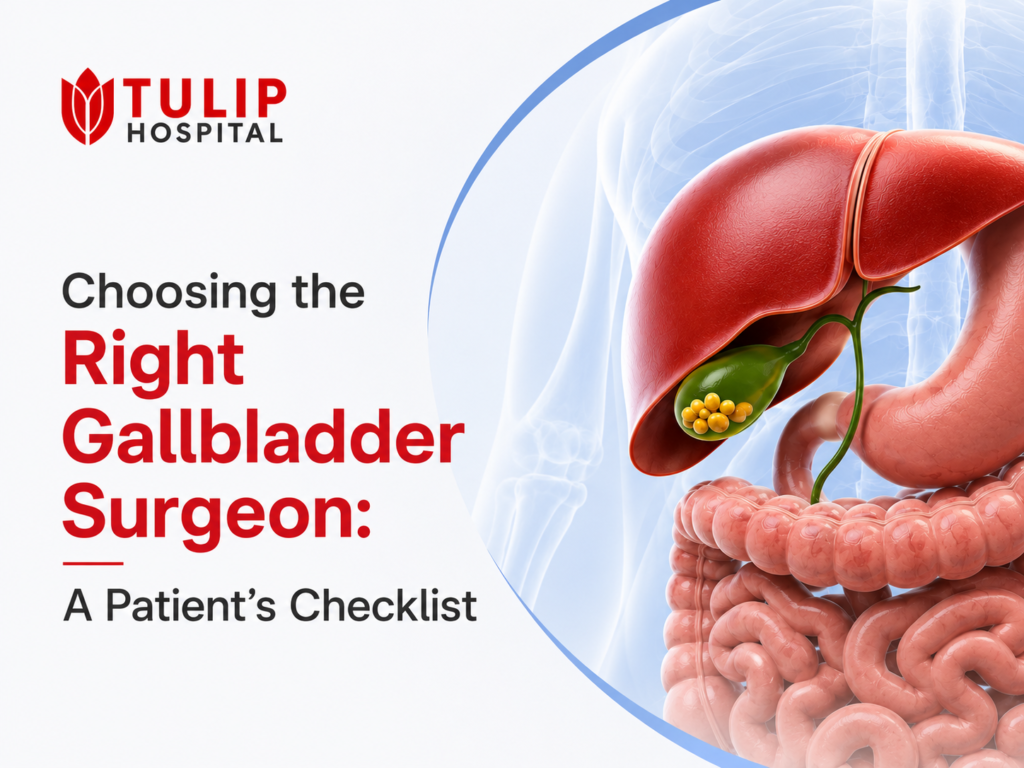
If your ultrasound report shows gallstones and your doctor has recommended surgery, the next decision — who performs it — matters almost as much as the diagnosis itself. Gallbladder removal, or cholecystectomy, is one of the most commonly performed abdominal surgeries, and for most patients it resolves symptoms reliably. Even so, outcomes and recovery experience can vary from surgeon to surgeon and hospital to hospital. If you’re evaluating a gallbladder surgeon in Kanpur, here is a practical checklist covering qualifications, surgical approach, hospital readiness, cost, and the questions worth asking before you fix a date.
Why the Choice of Surgeon Matters
Laparoscopic cholecystectomy — keyhole removal of the gallbladder — is the standard approach for symptomatic gallstones, and it is generally safe and well tolerated. Even so, outcomes are not identical for every patient. A review of clinical studies found that resolution of biliary pain after cholecystectomy ranges from about 66% to 100%, with some patients experiencing lingering symptoms linked to factors such as pre-existing digestive issues or a longer duration of symptoms before surgery. This variation is part of why a surgeon’s specific experience with GI surgery — not general surgery alone — can influence how smoothly your case and recovery go.
Check Qualifications and Specialization
Not every general surgeon performs gallbladder surgery with the same regularity. Before deciding, look for:
- A postgraduate qualification in general surgery (MS), ideally followed by a further degree in gastrointestinal or gastro surgery (DNB or MCh – Surgical Gastroenterology)
- Membership or fellowship with a recognized laparoscopic surgery body, such as FIAGES (Fellow of the Indian Association of Gastrointestinal Endo Surgeons)
- A stated focus on stomach, gallbladder, liver, or pancreas conditions, rather than a purely general surgical practice
A surgeon with GI-specific training has typically handled a wider range of gallbladder presentations — straightforward stones as well as more complicated cases, such as an inflamed or infected gallbladder — which matters if your case turns out to need more than a routine approach.
Ask About the Surgical Approach
Gallbladder stone surgery in Kanpur is usually offered through one of three methods:
- Laparoscopic cholecystectomy — small incisions and a camera-guided approach; the current standard of care for most patients
- Robotic-assisted surgery — built on the same minimally invasive principle, with robotic instruments offering added precision for select or more complex cases
- Open surgery — a larger incision, generally reserved for complicated cases or situations where a laparoscopic approach isn’t safe to complete
Ask your surgeon which approach they recommend for your case and why, and what their rate of converting a laparoscopic surgery to an open one has been. Conversion is not a failure — it is sometimes the safest call to make mid-surgery — but a surgeon should be able to discuss it candidly rather than avoid the question.
Understand the Hospital Setup
The surgeon’s skill matters, but so does the hospital around them. Before confirming a date, it helps to check:
- Whether the operation theatre is equipped for laparoscopic or robotic procedures, not just open surgery
- ICU or emergency backup, in case of an unexpected complication
- Anesthesia support and a clear pre-operative assessment process
- Clarity on the expected hospital stay, which for straightforward laparoscopic cases is typically a day or a few days
A hospital that runs a proper pre-op workup — blood tests, an ultrasound review, and an anesthesia fitness check — is generally a good sign of a structured surgical program.
Questions Worth Asking Before You Decide
- How many gallbladder surgeries do you perform in a typical month?
- Would you recommend laparoscopic, robotic, or open surgery for my case, and why?
- What is your rate of converting laparoscopic surgery to open surgery?
- What does the recovery timeline usually look like for a patient in my situation?
- What happens if a complication is found during the surgery?
- What exactly is included in the surgery cost, and what could add to it?
Frequently Asked Questions
What qualifications should I look for in a gallbladder surgeon?
Look for a surgeon with postgraduate qualifications in general surgery (MS) and, where possible, a further qualification in gastrointestinal or gastro surgery (DNB or MCh), along with membership in a recognized laparoscopic surgery body such as FIAGES.
Is robotic gallbladder surgery better than laparoscopic surgery?
Both are minimally invasive and built on similar principles. Robotic-assisted surgery can offer added precision for select or more complex cases, but for straightforward gallstone removal, laparoscopic cholecystectomy remains the well-established standard. Your surgeon can advise which suits your specific case.
How long is the hospital stay after gallbladder surgery?
For an uncomplicated laparoscopic cholecystectomy, hospital stays are typically short — often a day to a few days — though this can vary based on your overall health and how the surgery goes.
Does a lower-cost package mean lower-quality treatment?
Not necessarily, but a price noticeably lower than other quotes is worth questioning. Ask what the package includes — surgeon’s fee, OT charges, room category, and post-operative care — before comparing purely on cost.
What if my laparoscopic surgery needs to be converted to open surgery?
This can happen if the surgeon encounters unexpected inflammation, scarring, or unclear anatomy during the procedure. It’s a safety decision rather than a complication in itself, and a good surgeon will explain this possibility to you beforehand.
How soon should I have surgery after being diagnosed with gallstones?
This depends on your symptoms. Some patients with mild, occasional symptoms may be monitored, while those with recurring pain or complications like inflammation are usually advised to have surgery sooner. Your surgeon can guide the right timeline for your case.
Talk to a Gastro Surgeon
If you’ve been advised to consider gallbladder stone surgery, Dr. Abhinav Sengar (MBBS, MS, FIAGES, DNB – Gastro Surgery) sees patients at Tulip Hospital, Kakadeo, Kanpur, for a detailed evaluation of your reports and the surgical approach best suited to your case. Appointments can be booked by calling 7080999988 or 7080180033.
Doctor Bio / Medical Reviewer
Dr. Abhinav Sengar is a gastro surgeon with 14 years of experience, specializing in conditions of the stomach, gallbladder, liver, and pancreas. He holds MBBS and MS degrees along with a DNB in Gastro Surgery and is a Fellow of the Indian Association of Gastrointestinal Endo Surgeons (FIAGES). He practices at Tulip Hospital, 117/439, H Block, Pandu Nagar, Kakadeo, Kanpur.
Sources
- WebMD — Migraine vs. Tension Headache: How to Tell the Difference
- Kaiser Permanente — Migraines vs. Tension Headaches: Key Differences and Symptoms
- Comparison of gray matter volume between migraine and “strict-criteria” tension-type headache, National Center for Biotechnology Information (PMC)